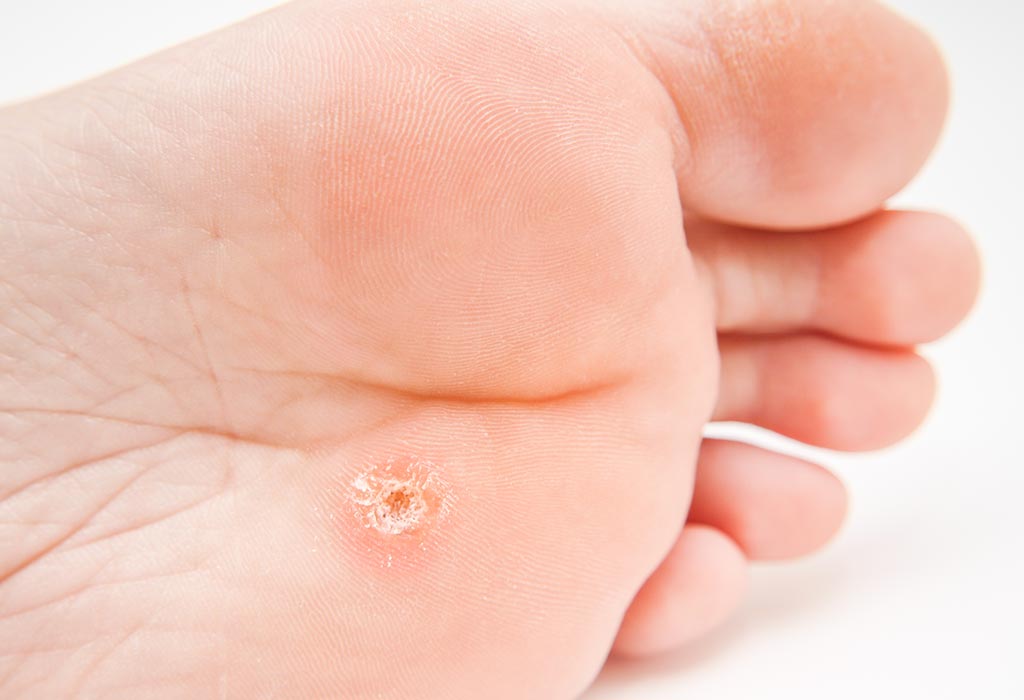
What are corns and what causes them?
When we walk or stand, our body weight is carried first on the heel and then on the ball of the foot where the skin is thicker to withstand the pressure. When this pressure becomes excessive, some areas of skin thicken and form corns, as a protective response to the friction of skin rubbing against bone, shoe or the ground.
Corns are caused by pressure or friction over bony areas, such as a joint, and they have a central core which may cause pain if it presses on a nerve.
There are five different types of corns, the most common of which are ‘hard’ and ‘soft’ corns:
– Hard corns – these are the most common and appear as a small area of concentrated hard skin up to the size of a small pea usually within a wider area of thickened skin or callus. This may be a symptom of the feet or toes not functioning properly.
– Soft corns – these develop in a similar way to hard corns but they are whitish and rubbery in texture and appear between the toes where the skin is moist from sweat or from inadequate drying.
– Seed corns – these are tiny corns that tend to occur either singly or in clusters on the bottom of the foot and are usually painless.
– Vascular/neurovascular corns – these are corns that have both nerve fibres and blood vessels in them. They can be very painful and bleed profusely if cut
– Fibrous corns – these arise when corns have been present for a long time and are more firmly attached to the deeper tissues than any other type of corn. They may also be painful.
How to prevent corns:
If you have corns, you can treat them yourself occasionally by gently rubbing with a pumice stone or a foot file when you are in the bath and applying moisturising cream to help soften thickened skin a little at a time, or relieve pressure between the toes with a foam wedge.
– wear thick, cushioned socks
– wear wide, comfortable shoes with a low heel and soft sole that does not rub
– use soft insoles or heel pads in your shoes
Do not:
– try to cut off corns yourself
– walk long distances or stand for long periods
– wear high heels or tight pointy shoes
– go barefoot
Surgical treatment:
For soft tissue lesions, like corns, that have failed all other conservative treatments, the option of a small surgical procedure is a possibility. Corns can be excised under local anaesthetic. Click here for more information on our corn excision treatment
 Essex Nail Surgery and Foot Centre